PewDiePie's Odysseus: The Creator Agent That Couldn't Pick a Lane
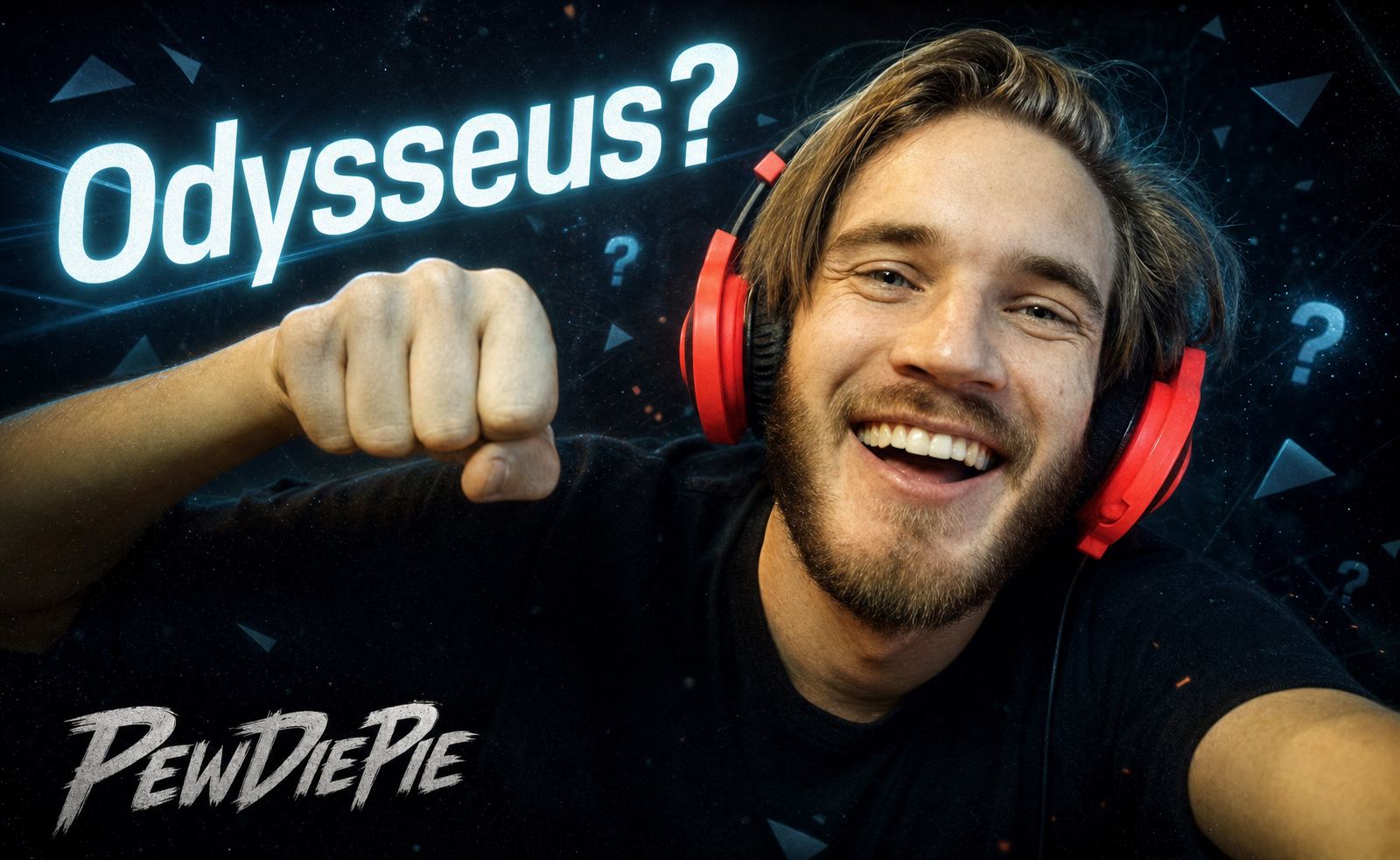
There is something weird about a YouTuber launching an AI agent. Not because it is impossible, and not because it is unimportant, but because it breaks the expected pattern. For years the agent story has been enterprise, research labs, cloud providers, and infrastructure teams. PewDiePie does not fit that narrative. The fact that he is now one of the faces of it says more about where the technology has landed than another hundred vendor keynotes.
PewDiePie’s new agent is called Odysseus. It is open source, it is already live, and it is ambitious in a way that is either interesting or obviously too wide, depending on how charitable you feel on the day. The selling point on paper is simple: a personal agent built for creators. In practice it reads more like a toolkit stitched together from the last few years of open source agent development and released under someone else’s name.
What Odysseus actually does
Odysseus is designed as a long-lived personal agent rather than a one-shot chatbot. It is meant to maintain task state, keep references across sessions, and act on integrations instead of only answering questions. The repo and published behaviour suggest five main roles.
First, it is a workflow assistant. It can attempt long-running tasks across files, web sources, and integrations instead of stopping at a single answer. Second, it claims memory persistence. Third, it claims integration routing. Fourth, it claims user-facing scripting or automation. Fifth, it claims creator-friendly workflows, presumably for video, scripting, scheduling, and topic research.
Those claims are not unique on their own. Almost every agent framework claims versions of the same things. The difference with Odysseus is not the feature list. It is the public execution, the creator positioning, and the fact that someone with tens of millions of subscribers just handed the project attention that most open source agent efforts never get.
How it is built
The project is built around modular components rather than one large binary. There is a core layer, an integrations layer, tooling around searches, and a companion-facing surface. That is not a flaw. It is the standard shape for an agent project that is still evolving.
What matters is how it exposes capability. Odysseus is not a silent local process only the operator can see. It is wrapped with a companion side that exposes behaviour to users. That choice changes the problem space enormously. A private agent is a reliability problem. A public-facing agent is a safety, brand, identity, and governance problem all at once.
The tech choices themselves are familiar. Local model support is present. Search and retrieval are present. Multi-step execution is present. Context management is present. None of these are new. The architecture is closer to a showcase than an invention.
What is actually interesting
The architecture is not the story. The story is the audience. PewDiePie did not simply announce a software project. He announced it in the language and tone of entertainment culture, then handed it to an engineering audience that does not usually watch entertainment culture for product signals. That collision is rare and usually tells you something about adoption ceilings.
The real test is not whether the architecture is clean. It is whether Odysseus can survive contact with creator workflows. Creator work is usually messy, opinionated, deadline-driven, and highly specific. An agent that only handles generic tasks will get replaced by the first faster specialized workflow. An agent that actually understands creator work has a much longer runway.
Odysseus also exposes an unresolved tension I keep seeing in agent projects. The more capable an agent becomes, the more public a product decision it becomes. That is not an engineering problem. It is a positioning problem. PewDiePie’s reach is enormous, but reach without control is not an asset in agent software. It is a liability.
Why this is a strange pivot
PewDiePie built his brand on one thing: commentary, reaction, and personality-first content. Agent software requires the opposite sensibility. It rewards precision, reliability, conservative defaults, and slow iteration. Those are not natural instincts for a creator whose job is to perform loudly, shift quickly, and remain entertaining first.
That is not a cheap shot. It is a structural observation. Creator-adjacent software projects run into the same wall every time. The audience expects novelty. The product needs stability. The brand expects fun. The system demands trust. When those pull in opposite directions, the project slows down.
I do not think Odysseus is a vanity project. It is too committed for that. But it is trying to do something that is extremely hard: build a useful agent platform inside a creator brand without letting the brand requirements poison the engineering requirements.
The creator agent category
There is a category forming here whether the industry admits it or not. Creator-first agents are not the same as productivity assistants. They are not the same as enterprise copilots. They are closer to bespoke automation for people whose workflows depend on research, scripting, scheduling, content planning, publishing, and constant context switching.
The mistake most people make with this category is assuming it needs a friendly UI and shortcuts. It does not. It needs reliability, repeatable behaviour, and clear boundaries. Creators will trade polish for predictability very quickly because their livelihoods depend on consistency.
Odysseus is one of the first projects attempting that pitch at scale. That alone makes it worth watching, even if the current execution is uneven.
Source: pewdiepie-archdaemon/odysseus
Connect with me on LinkedIn.